
You’re standing in front of a sweeping mountain valley. Golden hour is hitting perfectly. You raise your camera and the frame just doesn’t capture it. The scene feels massive. Your photo feels small. That’s the problem most landscape photographers hit eventually. And more often than not, the answer isn’t a new camera body. It’s a better lens specifically, a wide angle lens built for exactly this kind of shot.
These lenses allow you to capture more of the scene in a single frame, making foreground elements more dramatic and skies feel expansive. The result is a composition that feels immersive and visually engaging. However, not every wide perspective optic is the same, and picking the wrong one for landscapes can leave you with soft edges, heavy distortion, or images that just don’t do the scene justice.
In this guide, we’ll break down what actually makes a lens work for landscape photography, how to choose between different focal lengths, and which lenses are worth your money in 2026 including some of the sharpest, most affordable options available through LK Samyang.
Let’s get into it.
What Makes a Wide Angle Lens Best for Landscape Photography?
Not every wide angle lens is built the same. The focal length printed on the barrel is just the starting point. In fact, what really determines whether a lens performs outdoors in changing light, uneven terrain, and demanding conditions comes down to a handful of core qualities.
Focal Length
For landscape photography, you’re generally working in the 14mm to 35mm range (on full frame). The wider the focal length, the more scenes you pull in. For instance, a 14mm lens is dramatic and immersive. A 24mm feels natural and spacious. Meanwhile, a 35mm sits closer to how our eyes actually see the world. Each one serves a different creative purpose, so understanding focal length is step one.
Edge-to-Edge Sharpness
Landscapes test a lens in ways that portraits never do. When you’re capturing a rocky foreground, a lake, a mountain range, and a sky all in one shot every part of that frame needs to be sharp. Specifically, a lens that’s crisp at the centre but soft at the edges will ruin landscape shots. Therefore, look for lenses with consistent sharpness from corner to corner, especially when stopped down to f/8 or f/11.
Controlled Distortion
Wide angle lenses naturally produce some distortion; it’s a byproduct of the optics. But for landscapes, though moderate barrel distortion is manageable. What kills a shot is excessive distortion that bends horizons and warps the edges of your frame. Fortunately, good optical design keeps distortion in check without requiring heavy correction in post.
Aperture
Wide apertures like f/1.4 or f/2.8 matter more than you might think for landscapes especially in low light. Shooting at sunrise, sunset, or under night skies requires a lens that lets in plenty of light. Additionally, a fast aperture also gives you more creative flexibility when you want a foreground subject sharp against a softly blurred background.
Build Quality
Landscape photography means you’re out in the elements. Consequently, weather sealing, solid construction, and durable glass coatings make a real difference when you’re shooting in mist, dust, or cold. This is where Samyang lenses distributed locally by LK Samyang Pakistan punch well above their price.
Indeed, the brand has built a reputation for delivering sharp, well-corrected optics with strong build quality at a fraction of what premium brands charge. For landscape photographers who want serious optical performance without a serious price tag, they’re worth a close look.
Which Is Better for Landscape Photography: Ultra-Wide vs Standard Wide?
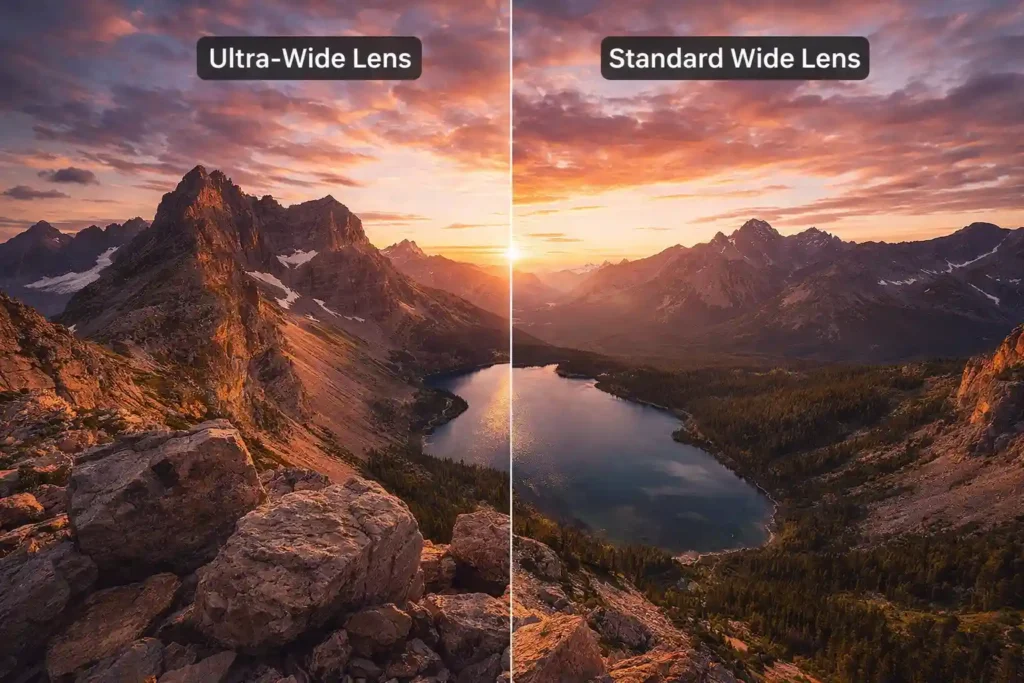
This is the question most photographers wrestle with before buying, and there’s no single right answer. Ultimately, the best focal length depends on what you’re shooting, how you shoot it, and the kind of images you want to come home with.
Here’s how to think about it.
Ultra-Wide (14mm–20mm): Big, Dramatic, Immersive
Ultra-wide options create an immersive feel, pulling viewers into the scene. They exaggerate depth, make foreground elements more dominant, and give skies a sweeping, cinematic look, especially in vast landscapes or dramatic environmental compositions and scale.
In particular, they work beautifully for:
- Mountain landscapes where you want to show scale
- Coastal and seascape photography with dramatic foreground rocks or waves
- Night sky and astrophotography where you need to capture a wide field of stars
- Interior architecture and tight locations where you can’t step back far enough
The trade-off? Ultra-wide lenses require more careful composition. Distortion is more visible, especially if you tilt the camera up or down. Furthermore, placing subjects near the edges of the frame can stretch them in ways that look unnatural. Used thoughtfully, though, the results can be extraordinary.
Standard Wide (24mm–35mm): Natural, Versatile, Travel-Friendly
Lenses in this range offer a more natural perspective, closer to how the human eye sees the world. They are easier to compose with, less prone to distortion, and ideal for travel, storytelling, and balanced landscape scenes.
Notably, they’re a strong choice for:
- Travel photography where landscapes, streets, and people all share the same shoot
- Forest and woodland scenes where an ultra-wide can feel chaotic
- Architecture and cityscapes that need clean, natural-looking lines
- Beginners who want versatility before specializing
So which should you choose?
- Go ultra-wide if you want dramatic, eye-catching compositions
- Choose standard wide if you prefer natural, storytelling images
Many photographers actually carry both, depending on the scene.
What Is the Best Wide Angle Lens for Landscape Photography?
The ideal choice for landscape photography is one that delivers sharp details, low distortion, and a focal length between 14mm and 24mm for maximum scene coverage. With that in mind, let’s look at specific lenses worth considering with a focus on what each one does best and who it’s best suited for.
| Samyang Lens | Key Specs | Best For & Skill Level |
| AF 14mm f/2.8 | 14mm f/2.8 | Mountains, astrophotography, coastlines • Beginner – Advanced |
| AF 24mm f/1.8 | 24mm f/1.8 | Detail-rich landscapes, travel, low light • Intermediate – Advanced |
| AF 35mm f/1.8 | 35mm f/1.8 | Travel, everyday landscapes, street • Beginner – Intermediate |
Best Ultra-Wide for Landscape Photography: Samyang AF 14mm f/2.8
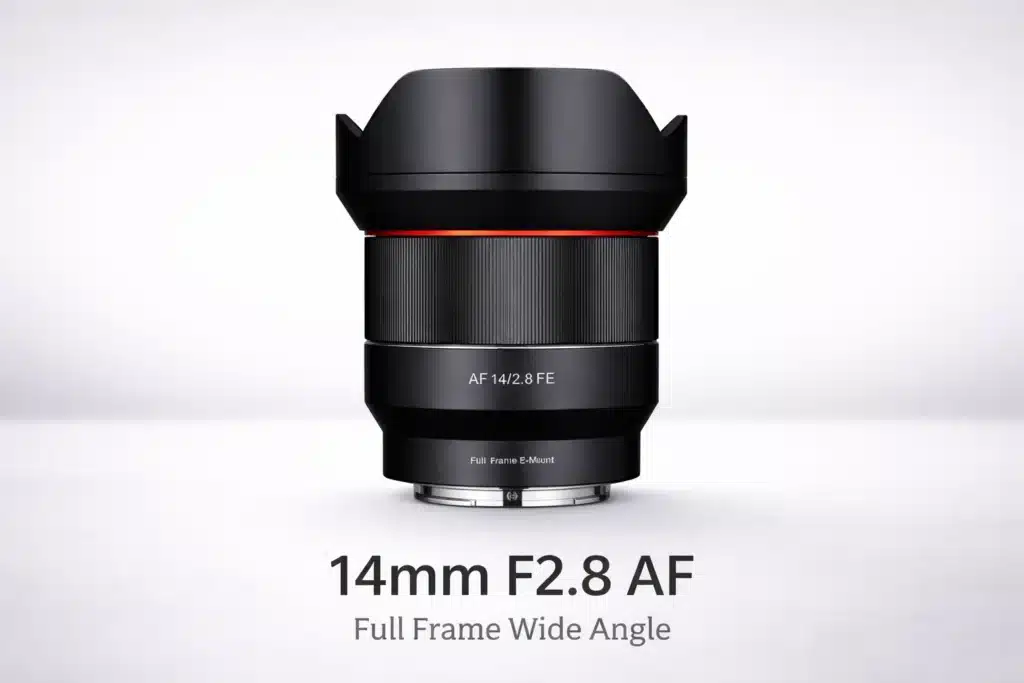
If you want a wide, sharp, affordable extra-wide lens this is one of the best options on the market at its price point. To begin with, the Samyang AF 14mm f/2.8 delivers impressive corner-to-corner sharpness, particularly when stopped down to f/8.
Distortion is well-controlled for a 14mm, and the autofocus version means you’re not manually hunting focus on every shot. Above all, the wide f/2.8 aperture makes it genuinely capable for astrophotography and blue-hour landscapes where light is scarce.
Best for: Mountain photography, astrophotography, sweeping coastlines, landscape beginners who want a serious tool without a premium price.
Best for Sharpness and Detail: Samyang AF 24mm f/1.8
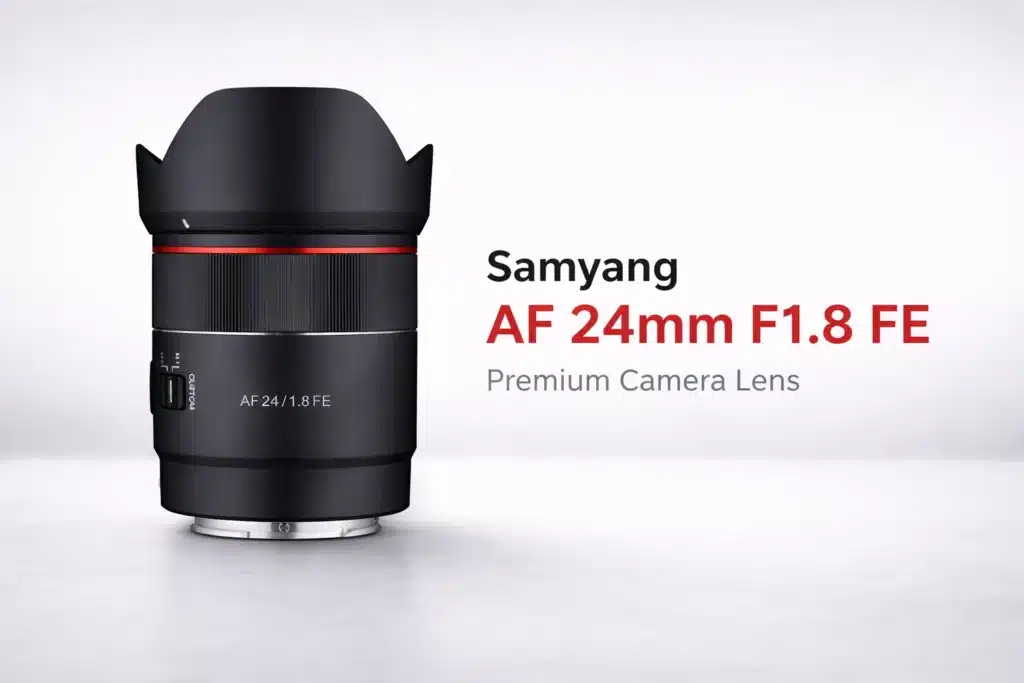
If sharpness is your priority, the 24mm f/1.8 is a standout. It renders fine detail grass, rock texture, water ripples with impressive clarity, even wide open. Similarly, the f/1.8 aperture also gives you genuine low-light capability for dawn and dusk shooting.
At 24mm, it sits in that sweet spot between dramatic wide perspective and natural field of view. Without doubt, it’s a focal length that experienced landscape photographers keep reaching for because it’s just “reliable.”
Best for: Experienced shooters who want optical quality, detail-rich landscape scenes, mixed-use shooting (travel + landscape).
Best for Beginners and Travel: Samyang 35mm f/1.8 AF
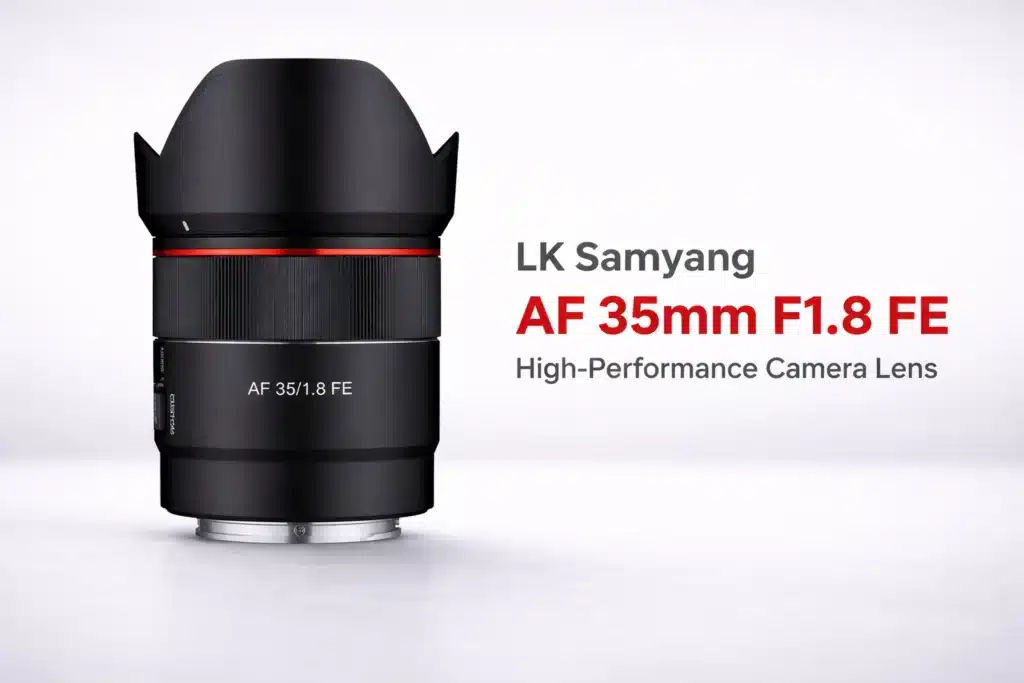
The 35mm is often overlooked for wide angle lens photography, but it’s one of the most practical lenses you can own. Not only is it compact and lightweight, but it’s optically excellent, and versatile enough to go from a mountain trail to a city street without missing a beat.
For travel photographers who want one lens that handles landscapes, architecture, food, and portraits a sharp 35mm f/1.8 is a smart starting point.
Best for: Travel photographers, beginners, photographers who want one lens for everything.
All of these lenses are available through LK Samyang Pakistan and represent some of the best value in wide-angle glass for landscape photography right now. Moreover, if you’re comparing wide angle lens price in Pakistan, Samyang consistently offers some of the most competitive pricing across full-frame and crop-sensor options without cutting corners on optical quality. Whether you’re just starting out or upgrading from an older lens, there’s a Samyang wide angle that fits where you are.
Pro tip: Instead of chasing the “perfect” lens, choose one that fits your shooting style and locations.
Tips for Better Wide Angle Landscape Photography
Owning a great wide angle lens is step one. Even so, getting the most out of it takes a little technique. Here are the habits that actually make a difference.
Use a Strong Foreground Anchor: Lenses with a wide field of view pull everything back and make the foreground prominent. Use that. Find rocks, flowers, water, or patterns near your feet and let them anchor the composition. As a consequence, a leading foreground element draws the eye through the frame and gives the image depth that flat compositions can’t match.
Get Lower Than You Think You Need To: Most landscape photographers don’t get low enough. The closer your lens is to the ground, the more dramatic and immersive the foreground becomes. Simply, drop to knee height. Try ground level. The perspective shift can completely transform an ordinary scene.
Shoot at f/8 to f/11 for Maximum Sharpness: Most lenses including Samyang glass hit their sharpest point around f/8 to f/11. For landscapes where you want everything in focus from foreground to horizon, this is your working aperture. In addition, use a tripod and a lower ISO to keep image quality clean.
Watch Your Horizons: Wide angle lenses exaggerate any tilt in your camera. A slightly crooked horizon looks far more noticeable at 14mm than at 50mm. To avoid this, use your camera’s level indicator or a hotshoe bubble level. Fix it in camera, not in Lightroom.
Shoot Golden Hour — But Don’t Skip Overcast Days: Golden hour light is beautiful with wide landscapes. Nevertheless, overcast skies diffuse harsh shadows and produce even, rich tones across the entire scene, great for forests, waterfalls, and coastal shots. Don’t pack up just because the sun disappeared.
Use the Rule of Thirds — Then Break It: Place your horizon on the upper third when foreground interest is strong. Alternatively, place it on the lower third when the sky is dramatic. But don’t be afraid to put the horizon dead centre for reflections and symmetry; sometimes it just works.
Focus One Third Into the Scene: For maximum depth of field without relying on hyperfocal calculations, focus roughly one third of the way into the scene. At f/8 or f/11 on a wide angle lens, this usually keeps everything from close foreground to the distant horizon acceptably sharp.
Final Thought
A wide angle lens is genuinely transformative for landscape photography. The right choice makes the difference between a photo that looks like a snapshot and one that feels like an experience. The good news? You don’t have to spend a fortune to get there. After all, LK Samyang has made optically excellent wide angle glass accessible and makes it easy to find the ideal option for your camera system and shooting style. Start with the focal length that matches your most common landscapes. Build technique around it. Then expand as your eye develops. The scene is already there. You just need the proper tool to capture it.
FAQs
What focal length should I use for the best landscape shots?
For landscape photography, a wide angle lens between 14mm and 35mm is ideal. They capture expansive scenes, dramatic skies, and foreground depth. A 24mm lens is a popular choice for balance. Longer focal lengths can also isolate distant elements, adding variety and creative storytelling to your compositions.
Is a wide-angle prime lens better than a zoom for landscapes?
A wide-angle prime lens offers sharper images, better low-light performance, and lighter weight. However, zoom lenses provide flexibility to adjust framing without changing position. Both are excellent for landscapes. Choose a prime for quality and simplicity, or a zoom for versatility during dynamic outdoor shooting conditions.
Can I take portraits with a wide-angle lens without distortion?
Yes, you can take portraits with a wide-angle camera lens if used carefully. Avoid getting too close to your subject, as this causes facial distortion. Keep the subject centered and maintain some distance. Wide perspective portraits can look creative and environmental, showing both the subject and their surroundings effectively.
Are ultra-wide angle lenses beginner-friendly for landscape photography?
Wide focal length lenses are beginner-friendly for landscapes because they capture more of the scene easily. They help create dramatic perspectives and depth. However, composition can be challenging. Beginners should practice framing, leading lines, and foreground interest to avoid empty or cluttered images in their shots.
